Top Maths Manipulatives: Foundation Year

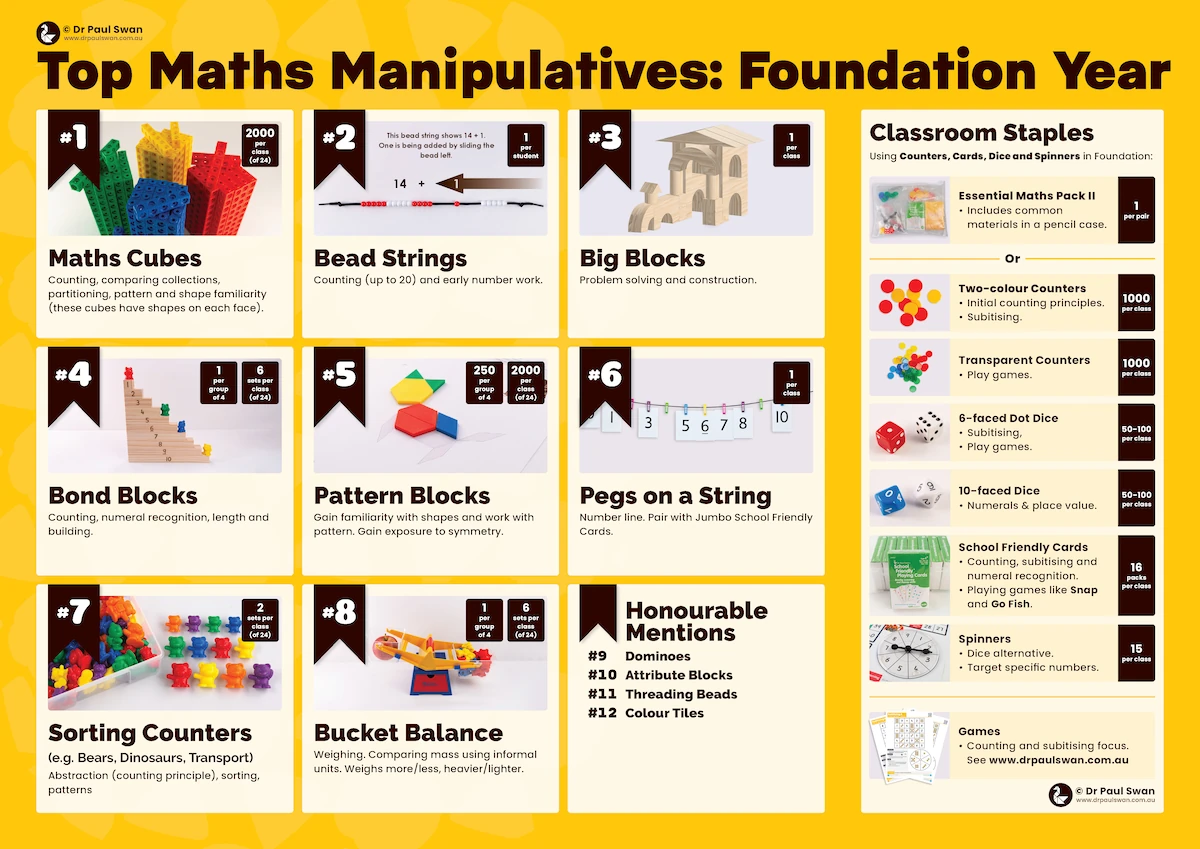
These are the absolute best manipulatives/materials/bits of equipment you can have in the Foundation Year.

Rankings are based both on a manipulatives’ irreplacability in teaching a topic and its versatility. Check our Curriculum page for more info on Curriculum connections.

The Foundation Year is a big year for maths manipulatives.

See below for our rankings and honourable mentions.

Ranking opinions provided by Dr Paul Swan and Narelle Rice.

#1

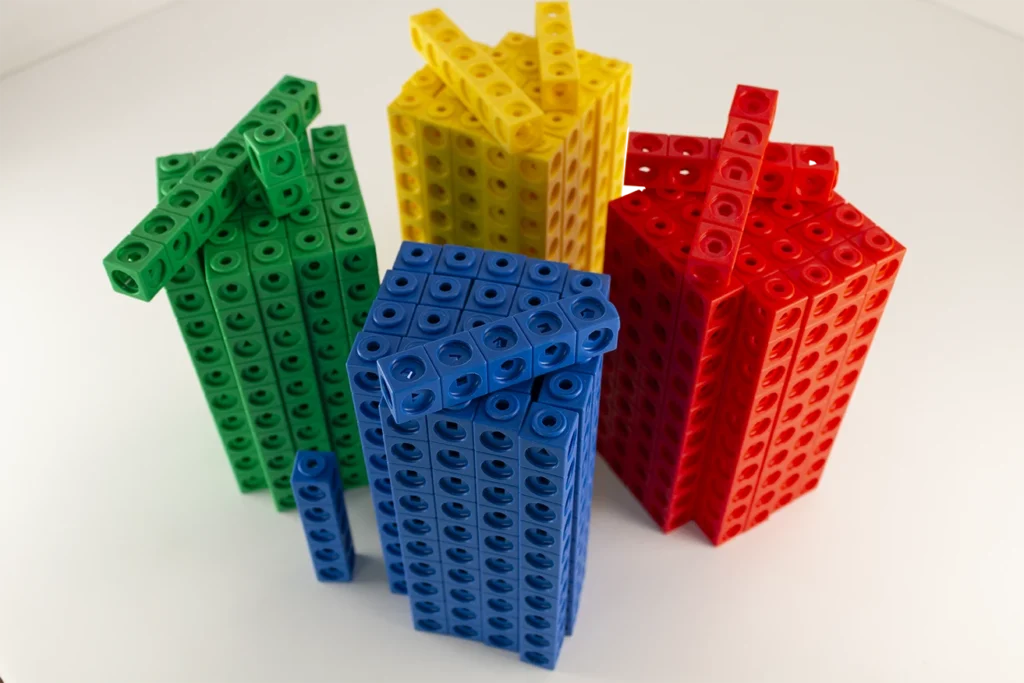
Maths Cubes

2000 per class (of 24)

Counting, comparing collections, partitioning, pattern and shape familiarity (these cubes have shapes on each face).

These cubes are ideal for young hands as they are made with soft plastic. The click together with just the right amount of resistance. The bonus is that they have a shape shown on each face. For number work I recommend buying cubes in four colours. – PS.

#2

Bead Strings

1 per student

Counting and early number work.

Learn to count on from any number. A simple manipulative that students and teachers find easy to use – PS.

bead strings

Counting, comparing collections, partitioning, pattern and shape familiarity.

#3

Big Blocks

1 set per class

Problem solving and building, shape, length and mass familiarity & comparison.

Ideal for the block corner, where students carry out construction and learn problem solving skills. Language such and longer, taller, wider, heavier will all be developed while building. -PS

#4

Bond Blocks

1 set per group of 4

#5

Pattern Blocks

250 per group of 4

Gain familiarity with shapes and work with pattern. Gain exposure to symmetry.

Pattern Blocks are a simple but versatile resource. Children love the way they form symmetrical patterns and tesselate.

#6

Pegs on a String

1 per class

Number line. Pair with Jumbo School Friendly Cards.

Peg numbers, words onto the string. Place the numbers in order. Look for missing numbers in a sequence. Pair with School Friendly cards. Children love pegging numbers on the string. It provides an opportunity for teachers to formatively assess students while watching them.

#7

Sorting Counters

(e.g. bears, dinosaurs, transport counters)

2 sets per class (of 24)

Abstraction (counting principle), sorting, patterns

Ideal for counting and developing the Abstraction Principle (one of the 5 counting principles). Sort according to size, shape colour. Classifying these counters requires students to use their problem solving and reasoning skills.

#8

Bucket Balance

1 set per group of 4

Weighing. Comparing mass using informal units. Weighs more/less, heavier/lighter.

Honourable Mentions

I think dominoes are an underrated resource. They are simple to use and easy to hand out and pack away if stored in a pencil case. Match the standard subitising patterns on dominoes.

Learn about shapes. Develop classification, problem solving and reasoning skills.

  • Threading Beads

Develop fine motor skill while learning about pattern.

A simple but effective resource. Arrange the 4 different colour 25 mm tiles to form patterns, create symmetrical patterns and learning about covering an area.

Classroom Staples at this Year

Essential Maths Pack

1 per pair of students

includes common materials in a handy bag.

Two-Colour Counters

1000 per class

This year: initial counting principles, subitising.

Transparent Counters

1000 per class

This year: used for playing games

6-faced dice

50 – 100 per class

This year: subitising & playing games

10-faced dice

50 – 100 per class

This year: numerals

School Friendly Cards

16 packs per class

This year: counting, subitising and numeral recognition. Playing games like Snap and Go Fish.

Spinners

15 per class

This year: dice alternative,  target specific numbers.

Games

Warm Ups

This year: Counting and subitising focus.

Sign up to the newsletter to never miss out!

These files are Copyright ©A-Z Type (Dr Paul Swan) Please see our full copyright notice.

Resources: Games | Puzzles | Teacher Planning | Interactives | Videos | Printables