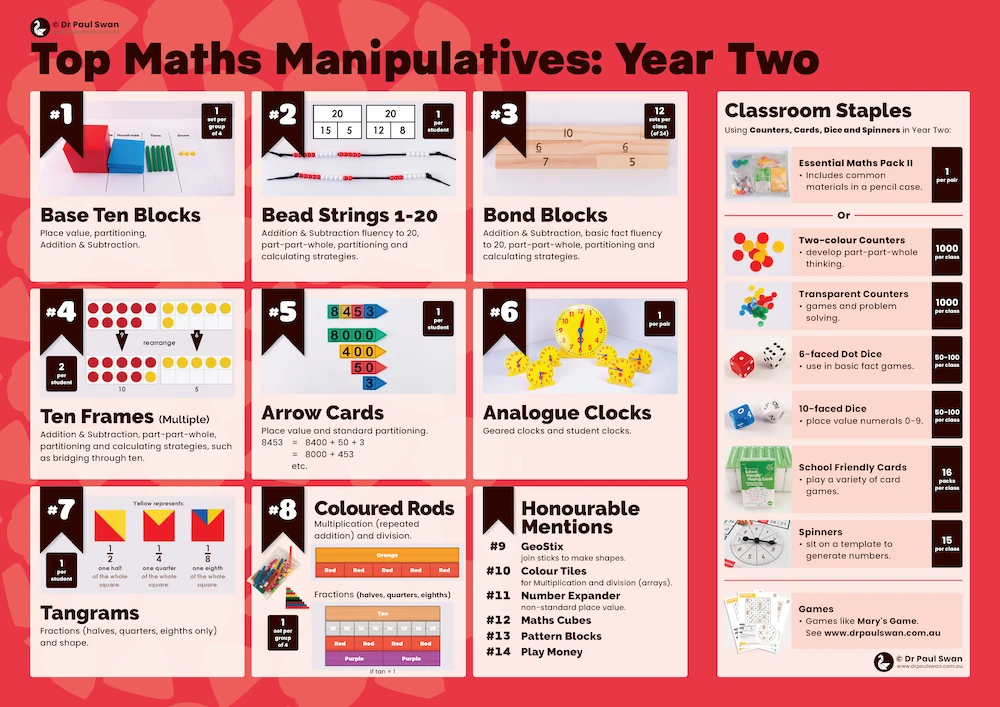
These are the absolute best manipulatives/materials/bits of equipment you can have in the Year 2.
Rankings are based both on a manipulatives’ irreplacability in teaching a topic and its versatility. Check our Curriculum page for more info on Curriculum connections.
Place value, partitioning, Addition & Subtraction.
Base Ten Blocks may be used to develop place value understanding and assist in developing calculation strategies for addition and subtraction. Using a place value mat with Base Ten Blocks will emphasise the place value nature of our base ten system. Students will need to trade or exchange 10 ones for 1 ten. -PS
Addition & Subtraction, basic fact fluency to 20, part-part-whole, partitioning and calculating strategies.
The Bond Blocks system for learning basic addition and subtraction facts can be used as a Tier 1 teaching system or to assist students needing extra support (Tier 2 or 3). See the many support materials freely available at the Bond Blocks Website www.bondblocks.com -PS
Addition & Subtraction, part-part-whole, partitioning and calculating strategies, such as bridging through ten.
Combining two ten frames and using counters or cubes of two different colours will help students learn addition and related subtraction facts to 20. Students can learn to bridge ten when adding numbers like 9 and 6, which becomes 9 + 1 + 5.
There are different aspects of place value. Arrow cards will help students understand that a number like 8 453 may be partitioned in different ways, such as the standard 8000 + 400 + 50 + 3, but the cards may also be rearranged as 8000 + 453 or 8400 + 53, which will support some calculation methods.
1 teacher clock per class, 1 student clock per student
Geared clocks and student clocks.
A geared clock is an ideal first clock as the hour hand moves between two hours as the minute hand moves around the clock. When the minute hand has moved halfway around the clock the hour hand will have moved halfway between two hours. At half past twelve, the hour hand will have moved half way between 12 and 1. Note Reading and analog clock requires the development of some fraction language (half, quarter) and ‘past’ and ‘to’ which is more difficult than digit language.
Fractions (halves, quarters, eighths only) and shape.
A cheap, simple but underestimated manipulative. The shapes might seem basic, 5 triangles (all right-angle isosceles triangles), a square and a parallelogram. All the shapes are related by area, which makes them a great manipulative to use when developing fraction understanding. We prefer the ‘soft n quiet’ tangrams (they don’t make a clanging noise on the desk). They are packed in four colours which makes it easy to separate a set in their seven pieces. The different colours make it easier to see the fraction (see picture)
Many schools have sets of coloured rods. They are an ideal ‘length based’ resource for developing fraction (and division) concepts. Equivalent fractions may be recognised when two fractions line up along a length, for example, ½, 2/4 and 4/8.
We like the soft plastic used to produce this product along with the easy to use ‘click and join’ mechanism. Students can create shapes and learn about their properties using this manipulative.
Pattern blocks are more than just shape blocks. They may be used to develop early ideas of area and fractions (like Tangrams), tessellation and symmetry.
Students rarely handle money, so they require shopping experiences that involved handing over money and receiving change. While handling money students will learn to recognise coins, count coins and learn about equivalence, that is 5 x 20c is the same total as $1