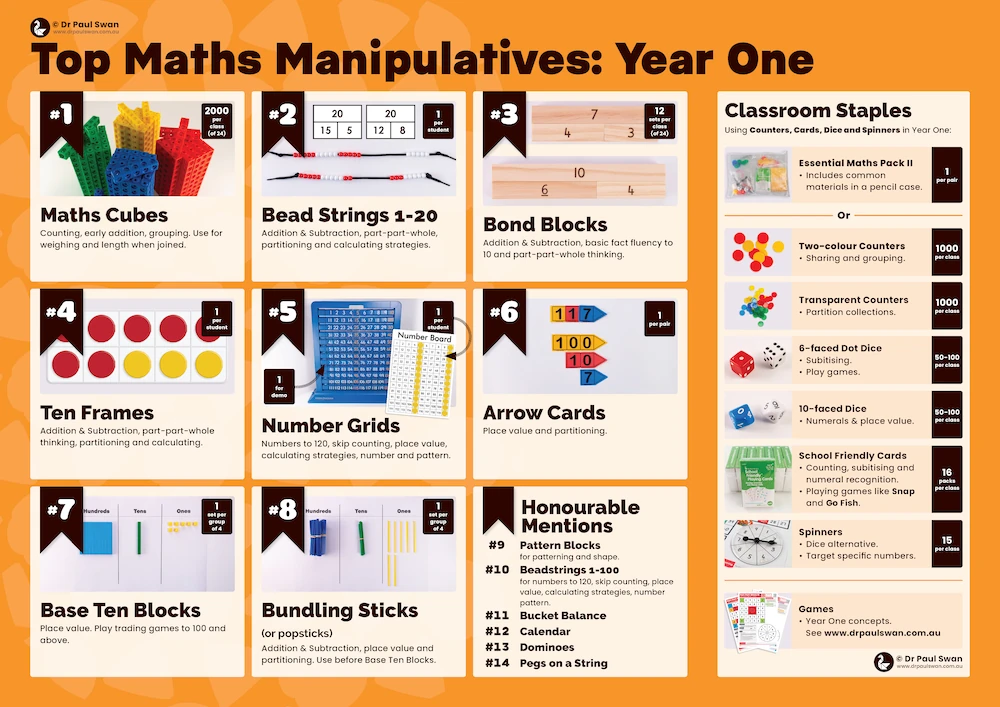
These are the absolute best manipulatives/materials/bits of equipment you can have in the Year 1.
Rankings are based both on a manipulatives’ irreplacability in teaching a topic and its versatility. Check our Curriculum page for more info on Curriculum connections.
Counting, grouping, calculating, shape, length, mass, multiplication and division.
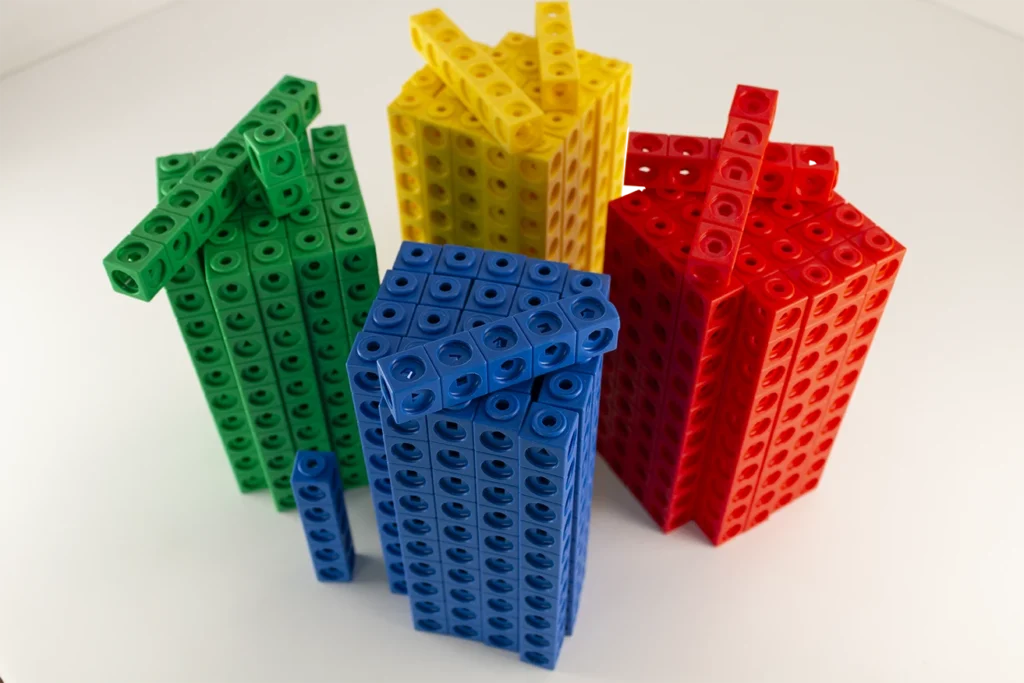
Listed at number 1 for their immense versatility at Year 1, these cubes are ideal for young hands as they are made with soft plastic. They click together with just the right amount of resistance. The bonus is that they have a shape shown on each face. For number work I recommend buying cubes in four colours. – PS.
Addition & Subtraction, part-part-whole, partitioning and calculating strategies.
Coming in at number 2 due to the importance of the concepts you teach with it, the five red five white bead string configuration supports struggling learners. I like the fact that the beads have a slight resistance as they move along the string. – PS.
Addition & Subtraction, basic fact fluency to 10 and part-part-whole.
Even if you don’t use the Bond Blocks Programs the blocks alone are worthy of their place at number 3 for their use with part-part-whole. If you’re just using the blocks, check out the free booklet here – PS.
Addition & Subtraction, part-part-whole, partitioning and calculating.
I recommend using two different colour counters to clearly show the partitions of ten. Two-sided counters where one colour is shown on one side and a different colour on the other side are ideal. If students lack the fine motor skills to pick up the counters Maths Cubes will fit in the Ten Frame. – PS.
There are different aspects of place value. Arrow cards will help students understand that 117 is 100 + 10 + 7 and 110 + 7 and 100 + 17, which will help with later calculation. – PS.
Place value, partitioning, Addition & Subtraction to 20.
Prior to using Base Ten Blocks, students need to bundle pop sticks or Bundling Sticks. Base Ten Blocks are pre-bundled and in proportion to each other. Using a Place Value Mat and placing the blocks in a ten frame configuration will help messy workers. – PS.
Addition & Subtraction, place value and partitioning. Use before Base Ten Blocks.
A small size elastic band (no 4) will help students bundle ten ones and exchange for one ten and later 10 tens are bundled to form 100. The bundling and exchanging process needs to occur BEFORE using Base Ten Blocks as Base Ten blocks are pre-bundled. – PS.
For numbers to 120, skip counting, place value, calculating strategies, number pattern.
Beads are grouped in tens to support Place Value understanding. If you add twenty beads from the 1 -20 bead string you can count to 120. – PS.
#11 Bucket Balance
As students compare the mass of objects, they will learn some things weigh more/less and some things weigh the same. They will associate balance with items weighing the same or having equivalent weights. – PS.
#12 Calendar
A calendar showing the whole year or at least a full month will help students see that there are repetitive cycles such a Monday repeating every seven days. Key events in the year can be marked on the calendar and the days counted down to the key event. – PS.
I think dominoes are an underrated resource. They are simple to use and easy to hand out and pack away if stored in a pencil case. Match the standard subitising patterns on dominoes. – PS.
Peg numbers, words onto the string. Place the numbers in order. Look for missing numbers in a sequence. Pair with School Friendly cards. Children love pegging numbers on the string. It provides an opportunity for teachers to formatively assess students while watching them.